In 49 BCE, Julius Caesar led his army across the Rubicon River, defying the Senate’s order to disband his forces. The act triggered civil war, but it did not begin the Republic’s crisis. The institutions of Rome had been under strain for decades.
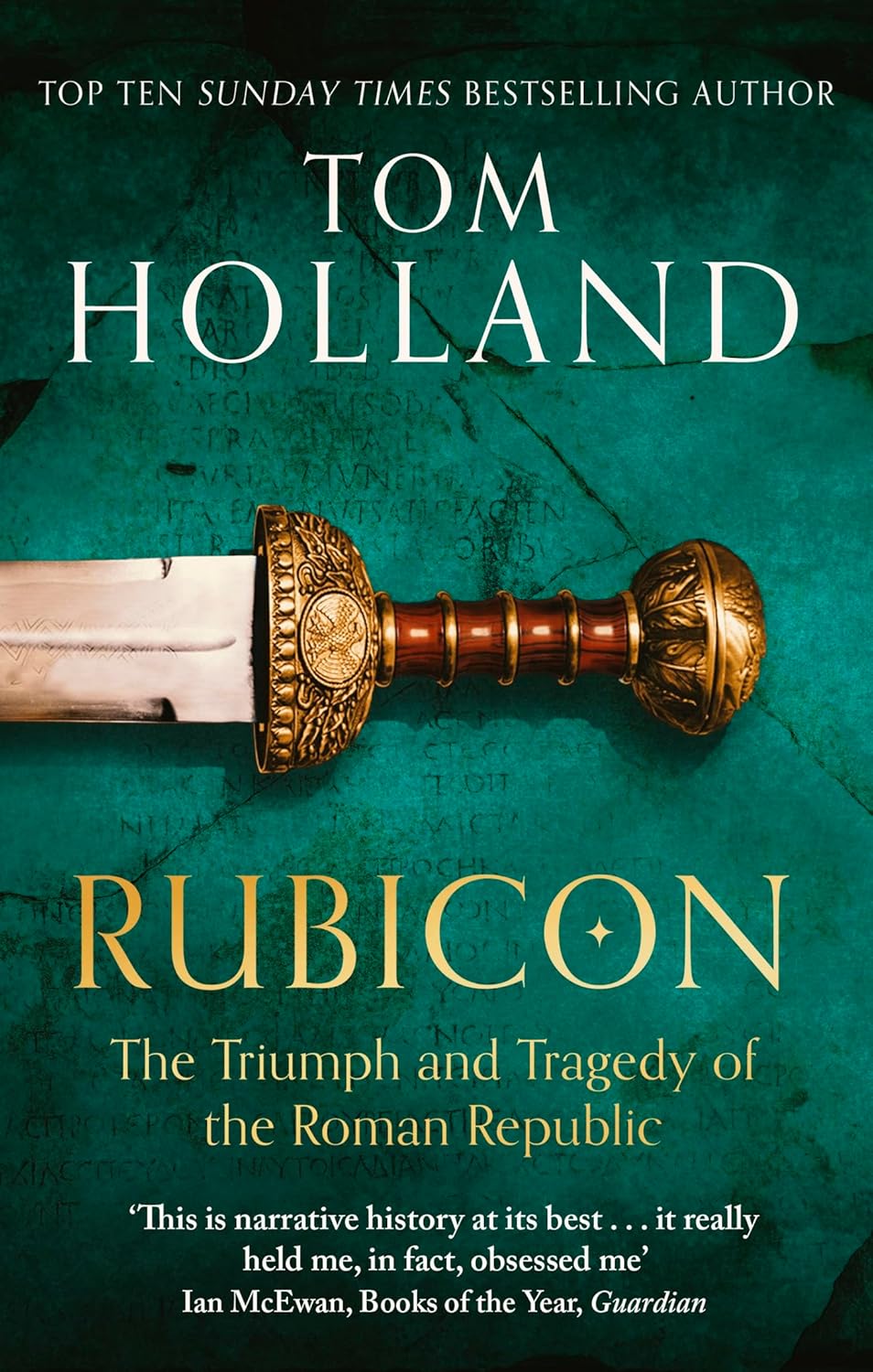
In Rubicon, Tom Holland turns to the century before Caesar’s dictatorship. He situates familiar figures within a longer pattern of political rivalry, constitutional tension, and escalating violence. The book stands as a narrative account of how republican governance gave way to personal rule.
What the book covers
Rubicon centres on the late Roman Republic, roughly from the Gracchi reforms through to Holland focuses on the period from the rise of Sulla in the 80s BCE to the aftermath of Caesar’s assassination. He is primarily concerned with how political competition eroded established norms and how individuals exploited institutional weaknesses. The book follows successive crises rather than treating the Republic’s fall as sudden.
He examines:
- The dictatorship of Lucius Cornelius Sulla and his constitutional reforms
- The political ascent of Pompey and Crassus
- The Catilinarian conspiracy and Cicero’s consulship
- The formation of the First Triumvirate between Caesar, Pompey, and Crassus
- Caesar’s campaigns in Gaul and his confrontation with the Senate
- The civil wars that followed Caesar’s crossing of the Rubicon
The narrative shows how repeated breaches of precedent reshaped expectations about power and authority.
What makes it different
Holland writes as a narrative historian with close attention to character and motive. He relies on ancient literary sources while weaving them into a continuous account that foregrounds political psychology as much as institutional change. His interpretation emphasises contingency and rivalry rather than inevitability.
Strengths
- Clear chronological structure that guides readers through complex events.
- Detailed portraits of key figures such as Sulla, Pompey, and Caesar.
- Strong explanation of how Roman offices and assemblies functioned in practice.
- Consistent focus on how precedent and personal ambition interacted.
It is often the book that draws readers deeper into Roman history.
Limitations
- The reliance on ancient narrative sources limits engagement with archaeological or economic evidence.
- Social and provincial perspectives receive less sustained attention than elite politics.
- Readers seeking extensive historiographical debate may find the analysis primarily narrative.
Who should read Rubicon?
- Readers interested in the political history of the late Roman Republic.
- Those looking for a structured account of Caesar’s rise within broader instability.
- General readers seeking clarity on Roman institutions and rivalries.
- Students beginning to explore first-century BCE politics.
Final assessment
Rubicon offers a focused narrative of how competition among Rome’s leading figures weakened republican structures. Tom Holland presents the Republic’s collapse as the outcome of cumulative decisions rather than a single turning point. The book occupies a clear place within popular narrative history of the late Roman Republic.