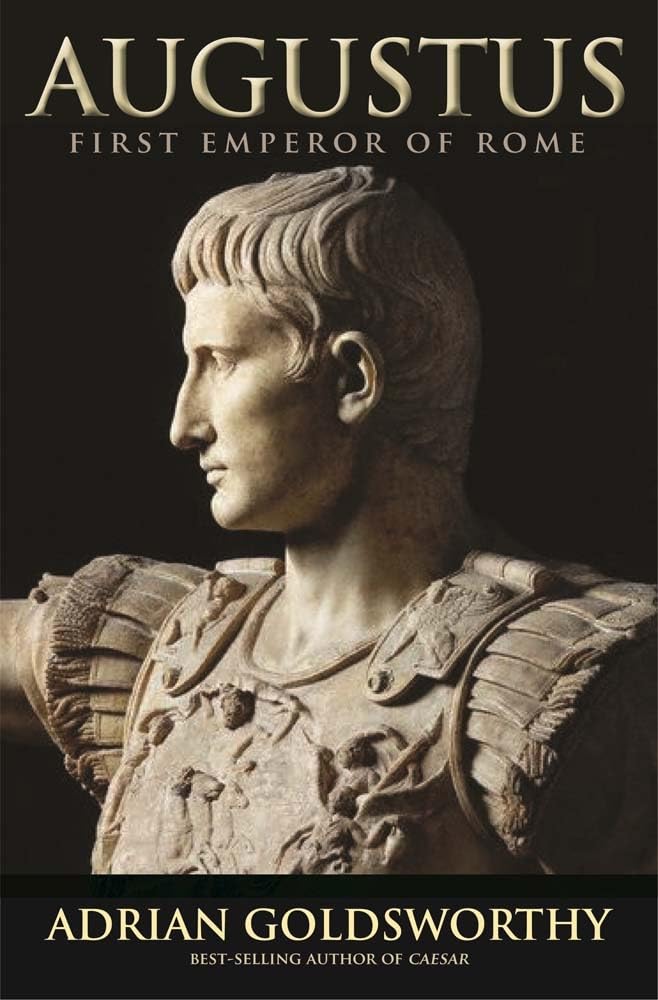
In 44 BCE, an eighteen-year-old Octavian learned that Julius Caesar had named him heir. Within months, he was manoeuvring among seasoned generals and senators. The Roman world was already unstable, and survival required calculation as much as force.
In Augustus, Adrian Goldsworthy follows Octavian’s transformation into Rome’s first emperor. The book situates his career within the final decades of the Republic and the consolidation of a new political order. It stands as a full-length biography grounded in military and institutional history.
What the Book Covers
Goldsworthy covers the period from Octavian’s youth in the 60s BCE to his death in 14 CE. He is primarily concerned with how Augustus secured power and maintained it for four decades. The narrative follows military campaigns, political settlements, and personal relationships that shaped the early Principate.
He examines:
- The aftermath of Caesar’s assassination and the formation of the Second Triumvirate
- The rivalry with Mark Antony and the campaign culminating at Actium
- The constitutional settlements of 27 and 23 BCE
- The management of the Senate and provincial administration
- Marriage alliances and the role of Livia and the Julio-Claudian family
- The succession arrangements leading to Tiberius
The book shows how Augustus balanced military authority with republican forms to stabilise his rule.
What makes it different
Goldsworthy writes as a military historian with strong command of Roman institutions. He relies closely on ancient sources, weighing their biases while maintaining a continuous narrative. His interpretation presents Augustus as pragmatic and adaptable rather than ideologically driven.
Strengths
- Clear explanation of how republican offices were reshaped under Augustus.
- Detailed treatment of military campaigns alongside political negotiation.
- Balanced assessment of Augustus’s character without speculation.
- Strong integration of personal life and statecraft.
Limitations
- Cultural and social history receives less attention than political and military affairs.
- Limited engagement with archaeological evidence compared to literary sources.
- Readers seeking theoretical analysis of imperial ideology may find the focus practical rather than conceptual.
Who should read it
- Readers interested in the transition from Republic to Empire.
- Those seeking a structured biography of Rome’s first emperor.
- Students of Roman political institutions.
- General readers looking for a clear account of Augustan rule.
Final assessment
Augustus presents a measured account of how one individual consolidated authority after decades of civil war. Adrian Goldsworthy situates Augustus within the institutional realities of Rome rather than treating him as an isolated figure. The book occupies a solid place within modern biographical studies of the early Roman Empire.