In 133 BCE, Tiberius Gracchus stood before the Roman assembly proposing land reform. His death at the hands of fellow Romans marked a turning point in political conduct. From that moment, violence and procedural shortcuts became part of public life.
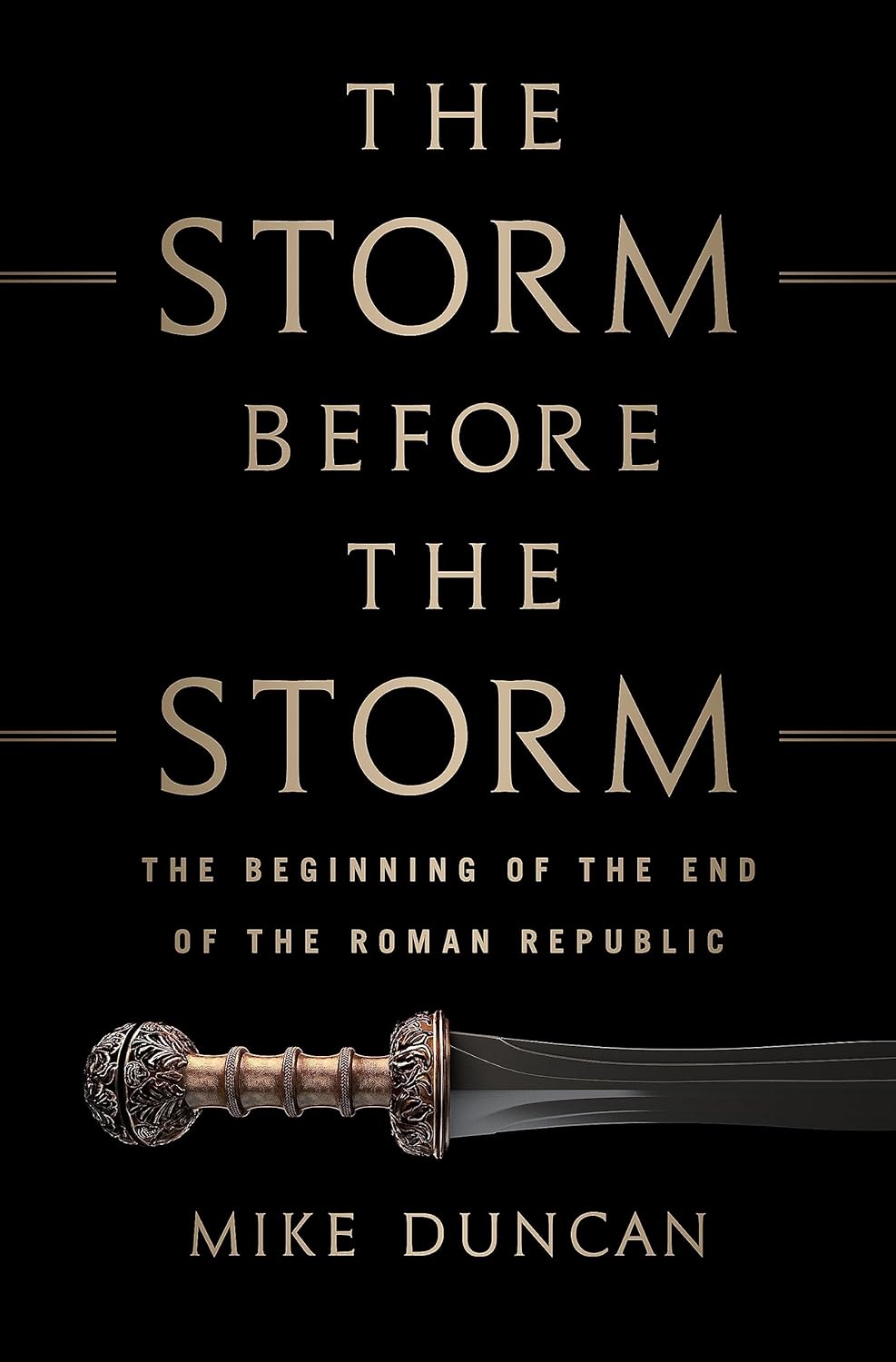
In The Storm Before the Storm, Mike Duncan turns to this earlier phase of instability. Rather than beginning with Caesar or Pompey, he examines the generation that set new precedents in political competition. The book situates the Republic’s later collapse within these formative decades.
What the book covers
The Storm Before the Storm concentrates on the decades between the tribunate of Tiberius Gracchus in 133 BCE and the aftermath of Sulla’s dictatorship. Rather than beginning with Caesar, Duncan focuses on the earlier breakdown of political restraint. His central concern is how repeated confrontations altered expectations about power and procedure.
He examines:
- The land reforms proposed by Tiberius and Gaius Gracchus
- The rise of popularis politics and resistance within the Senate
- The military career of Gaius Marius and the consequences of army reform
- The rivalry between Marius and Sulla
- The use of proscriptions and constitutional revision under Sulla
The emphasis is on precedent. Duncan argues that once violence, emergency powers, and personal armies entered political competition, they became available tools for later generations.
What makes it different
Duncan approaches the subject as a narrative historian with a strong grasp of institutional detail. Drawing closely on ancient sources, he reconstructs political events in sequence while explaining how procedures of the Roman Republic functioned in practice. His interpretation emphasises continuity between early reform crises and the later collapse of republican governance.
Strengths
- Clear chronological structure that makes a complex period easy to follow.
- Careful explanation of Roman political offices and procedures without excessive technical language.
- Strong focus on cause and effect, showing how individual decisions reshaped institutions.
- Integration of lesser-known figures alongside major names, widening the political landscape.
Limitations
- The narrative relies heavily on literary ancient sources, whose biases are acknowledged but unavoidable.
- Social and economic contexts receive less sustained attention than political conflict.
- Readers seeking detailed historiographical debate may find the analysis more interpretive than argumentative.
Who should read the book
- Readers interested in the Roman Republic beyond the careers of Caesar and Augustus.
- Those looking for a structured account of late republican political crises.
- General readers seeking clarity on how Roman institutions functioned.
- Students wanting an accessible entry point into first-century BCE politics.
Final assessment
The Storm Before the Storm offers a focused account of the political disruptions that preceded the Republic’s final collapse. Mike Duncan situates later upheavals within a longer pattern of reform, reaction, and institutional strain. The book stands as a clear narrative study of how republican norms were weakened decades before Caesar crossed the Rubicon.