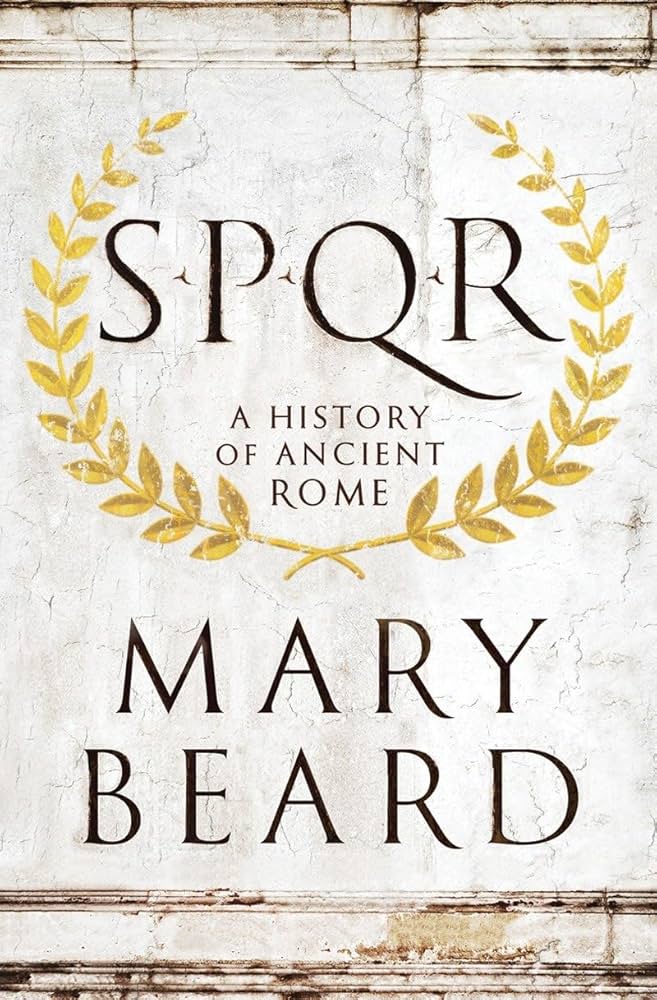
Few recent books have reshaped popular understanding of ancient Rome as effectively as SPQR. Published in 2015, Mary Beard’s study quickly became one of the most widely read modern accounts of Roman history. It is frequently recommended to general readers, assigned in university courses, and cited in debates about empire, citizenship, and political power.
But what kind of book is it? And is it the right place to start if you want to understand Rome?
This review looks at what SPQR does well, where it is more demanding, and who is likely to benefit most from reading it.
What the book covers
SPQR spans the early foundations of Rome through to the extension of citizenship in 212 CE. Rather than offering a conventional chronological sweep of emperors and battles, Beard is primarily interested in how Roman political culture functioned.
She examines:
- The myth-making surrounding Rome’s origins
- The development of the Republic
- The transformation of citizenship
- How Romans defined power and authority
- The realities behind well-known figures such as Cicero and Augustus
The focus is less on military drama and more on institutions, identity, and political argument.
What makes SPQR different
Many Roman histories still follow the traditional “rise and fall” narrative.
Beard deliberately avoids this structure.
Instead, she asks:
- How did Romans understand their own past?
- How did political language shape power?
- What did “citizenship” mean in a society built on slavery?
This gives the book a modern analytical feel. It reads less like epic storytelling and more like a conversation about how history is constructed.
That intellectual framing is one of its main strengths.
Strengths
- Written by a respected Cambridge historian
- Accessible without being simplistic
- Challenges common myths
- Strong emphasis on primary evidence
- Thoughtful, often witty prose
It’s serious history, but not dense academic writing.
Limitations
It is not:
- A fast-paced narrative history
- A military campaign account
- A biography-driven story
Readers looking for dramatic storytelling (in the style of Tom Holland, for example) may find it slower.
It also stops in the early third century, so it does not cover the later imperial decline.
Who should read SPQR?
This book is ideal for:
- General readers who want more than surface-level Rome
- Students beginning Roman history
- Readers interested in political culture
- Anyone curious about how modern historians reinterpret ancient evidence
It may not suit readers primarily looking for battlefield drama or sweeping chronological storytelling.
Final assessment
SPQR has become one of the defining modern books on Rome for good reason. It combines scholarly authority with readability and challenges simplistic ideas about empire and power.
For most readers, it is an excellent starting point — provided you are interested in how Rome worked politically, not just in what happened.